

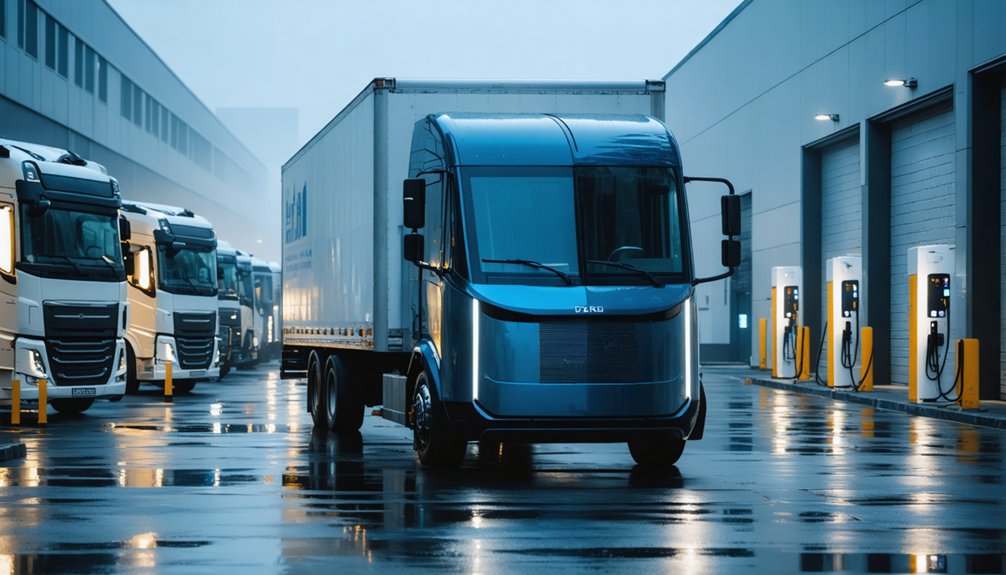

Electric trucks are gaining market share because they offer lower total operating costs, stronger policy support, and improving performance. Electricity can cost about $6.58 for 50 miles versus $18.56 for diesel, while maintenance is also lower. Regulations in California, Oregon, and other markets are pushing zero-emission sales, backed by tax credits and climate funding. Better batteries, smarter management systems, and expanding charging networks are making electric trucks more practical across light-duty and regional fleet use.
Highlights
- Electric trucks lower operating costs, with cheaper electricity and reduced maintenance improving total cost of ownership versus diesel.
- Government mandates, tax credits, and zero-emission sales targets are accelerating electric truck adoption across major markets.
- Battery improvements are increasing range, reliability, and performance, making electric trucks practical for more commercial applications.
- Growth in charging infrastructure, including depot, corridor, and pilot technologies, is reducing range anxiety and supporting fleet deployment.
- Urban delivery and light-duty use cases fit electric trucks well, helping them gain share where routes are predictable and efficiency matters most.
Why Electric Trucks Are Gaining Market Share
Electric trucks are gaining market share because regulatory pressure, improving economics, and advancing battery performance are aligning at the same time.
Market dynamics remain strong: forecasts range from USD 19.31 billion in 2026 to USD 72.11 billion by 2031, while stricter CO₂ and NOₓ rules raise regulatory compliance urgency. Europe held 36.77% of the global market in 2025, making it the largest regional market. In Europe, electric trucks are projected to reach about 14% of production by 2030, highlighting rising production share.
Battery‑electric models lead market segmentation, supported by technology adoption, policy subsidies, financing incentives, and infrastructure investment. Statista’s 2021 data also tracks global truck volume projections for the worldwide electric‑truck market from 2018 to 2026.
In urban freight, delivery infrastructure, consumer demand, and public perception reinforce fleet electrification.
Asia Pacific leads through industry partnerships, supply chain scale, and subsidy‑backed competitive terrain advantages.
Light‑duty trucks dominate practical use cases, while 301–500 kWh packs balance range and reliability.
Corporate ESG goals, consumer perception, environmental impact, and cost‑benefit analysis further support adoption.
The future outlook remains favorable across global markets.
How Lower Operating Costs Boost Electric Trucks
Much of that market momentum is explained by operating economics. Across urban and regional fleets, electricity consistently delivers a lower fuel cost than diesel. Battery-electric trucks are projected as the least-cost option for most vehicle classes before 2030. For example, a 50-mile trip can cost about $6.58 on U.S. AC charging compared with $18.56 for diesel, underscoring electricity’s lower fuel cost.
At 90,000 kilometers annually, energy spending can fall from $45,931 for diesel to $14,337 for electric.
Per-mile comparisons show a similar pattern: diesel trucks often run near $0.81 per mile, while electrics range from roughly $0.24 to $0.50, depending on charging rates and duty cycles.
Maintenance savings reinforce that advantage. Electric trucks avoid oil changes, reduce engine-related service, and benefit from regenerative braking that extends brake life.
Average annual maintenance runs about $3,421 for electric models versus $4,295 for gas equivalents. In Pennsylvania, that yearly savings comes to just under $900 for EV drivers.
For fleets focused on dependable, shared progress, these lower operating expenses increasingly support total cost of ownership parity and broader adoption.
Why Regulations Favor Electric Truck Adoption
Policy is another major force behind rising electric truck adoption. State rules are steadily reshaping fleet decisions. Oregon joined California-aligned standards, becoming one of 10 states adopting zero-emission truck requirements. Oregon’s proposed clean truck rules also add an optional credit program that gives manufacturers temporary compliance flexibility through 2026 credit flexibility.
California’s Advanced Clean Trucks rule requires 11% zero-emission medium-duty truck sales and 7% heavy-duty tractor sales in 2025, with much higher targets by 2035. These signals give manufacturers and fleets a clear path to follow together. However, major industry groups such as the ATA have argued that some federal mandates were unachievable under real-world trucking conditions.
Federal support strengthens that direction. The Inflation Reduction Act expanded tax credits for commercial clean vehicles, charging equipment, and qualifying used models, while adding grants and rebates for heavy-duty replacements. The law also authorized $391 billion for climate initiatives, marking the largest U.S. investment in climate mitigation to date largest climate investment. At the same time, regulatory incentives and flexible compliance credits help manufacturers manage the shift. Safety and charging standards from FMCSA and state agencies also build confidence that adoption is increasingly practical, coordinated, and durable nationwide.
How Battery Tech Makes Electric Trucks Practical
Regulatory momentum matters, but battery technology is what makes electric trucks workable at fleet scale.
New chemistries and pack designs are raising range, charging speed, safety, and durability at the same time.
Early solid state systems entering commercial use in 2026 promise higher energy density and longer life, with demonstrator cells already exceeding 600 stable cycles at high power.
Silicon‑carbon anodes lift energy density by 20 to 40 percent, while advanced cathodes improve fast charging without sacrificing lifespan. MIT and other global research groups are also advancing fast charging through new ion transport methods and layered electrode designs.
Just as important, cellless designs and structural packs reduce inactive material and use more pack volume for energy storage.
24M’s Electrode‑to‑Pack approach targets 80 percent active volume and 50 percent more range.
Intelligent battery management systems add predictive maintenance, fault detection, and stronger cold‑weather resilience, helping fleets operate with greater confidence together. AI‑driven platforms now deliver real time health assessment and early fault detection, reducing safety risks while extending battery life.
Those same systems also support real-time grid response, allowing electric trucks to participate in bidirectional charging and grid services as V2G infrastructure expands.
Where Electric Trucks Are Growing Fastest
Three regional patterns stand out in electric truck growth: Asia‑Pacific leads on scale, Europe advances through steady commercial deployment, and North America accelerates through incentives and infrastructure pilots.
Asia‑Pacific holds 41.7% of the market in 2026, led by China’s manufacturing depth and market regional policy support, while India, Japan, and South Korea expand fleets and regional charging. Corporate ESG commitments are further accelerating adoption across the region, reinforcing Asia‑Pacific’s market leadership.
Europe shows disciplined adoption. Electric trucks are forecast to reach 14% of production by 2030, with Western Europe strongest and battery‑electric models dominating daily routes and depot operations under tighter emissions rules.
North America is scaling through wireless charging pilots, hydrogen corridor funding, and state mandates targeting 40–50% zero‑emission Class 8 sales by 2032. North America also led the electric pickup market with a value of USD 1.67 billion in 2024, reflecting its leading share. Global electrified medium‑ and heavy‑duty truck sales are projected to rise from about 31,000 units in 2016 to nearly 332,000 by 2026, underscoring the sector’s rapid growth.
South America adds geographic diversification, especially through mining fleet electrification grants in Chile, Brazil, and Peru.
Why Light-Duty Electric Trucks Lead Demand
Because urban logistics and last-mile delivery continue to expand, light-duty electric trucks lead demand by matching the operational profile of city fleets more closely than heavier segments.
Rising urban demand from e-commerce, municipal services, and short-haul distribution aligns with predictable daily routes and 150–300 mile battery-electric range.
Market data reinforces that fit. Light-duty models hold the largest share in 2026, while North America accounts for 41.09% of the global light-duty market in 2025, supported by strong last-mile adoption and programs such as Rivian-Amazon deployment.
Battery improvements, including greater efficiency and LFP cycle life, strengthen reliability for dense urban duty cycles. Operators also see lower energy and maintenance costs, with total cost of ownership advantages supporting battery electric vehicles at 44.3% market share in 2026. Emissions rules and fleet incentives accelerate adoption further.
What Could Slow Electric Truck Market Growth?
What, then, could slow electric truck market growth despite strong demand signals? Several barriers remain material.
High upfront costs still exceed diesel, especially for smaller fleets and in emerging markets where subsidies have weakened. Brazil’s reinstated IPI tax, India’s expired FAME II grants, and South Africa’s battery-pack duties have all widened price gaps and delayed replacement cycles.
Charging infrastructure gaps also continue to limit confidence. Sparse depot and corridor charging, permitting delays, and slow interconnection timelines reduce vehicle utilization and push fleets toward larger, costlier battery packs. Range limits and degradation concerns reinforce caution on long-haul routes.
Meanwhile, supply chain constraints in lithium, rare earths, and some components continue to pressure battery pricing and manufacturing output, while policy volatility and weak standardization slow broad fleet adoption globally.
References
- https://www.statista.com/statistics/1273761/electric-truck-worldwide-market-forecast/
- https://www.coherentmarketinsights.com/market-insight/electric-truck-market-6008
- https://www.spglobal.com/automotive-insights/en/blogs/2026/02/commercial-vehicle-market-outlook-sees-steady-gains
- https://www.datainsightsmarket.com/reports/north-america-electric-truck-market-15478
- https://www.einpresswire.com/article/889243172/global-electric-truck-market-report-2026-business-expansion-key-development-drivers-and-trends-through-2030
- https://ev-volumes.com
- https://www.grandviewresearch.com/industry-analysis/electric-trucks-market
- https://caredge.com/guides/electric-vehicle-market-share-and-sales
- https://www.researchandmarkets.com/report/electric-truck
- https://www.mordorintelligence.com/industry-reports/electric-truck-market