

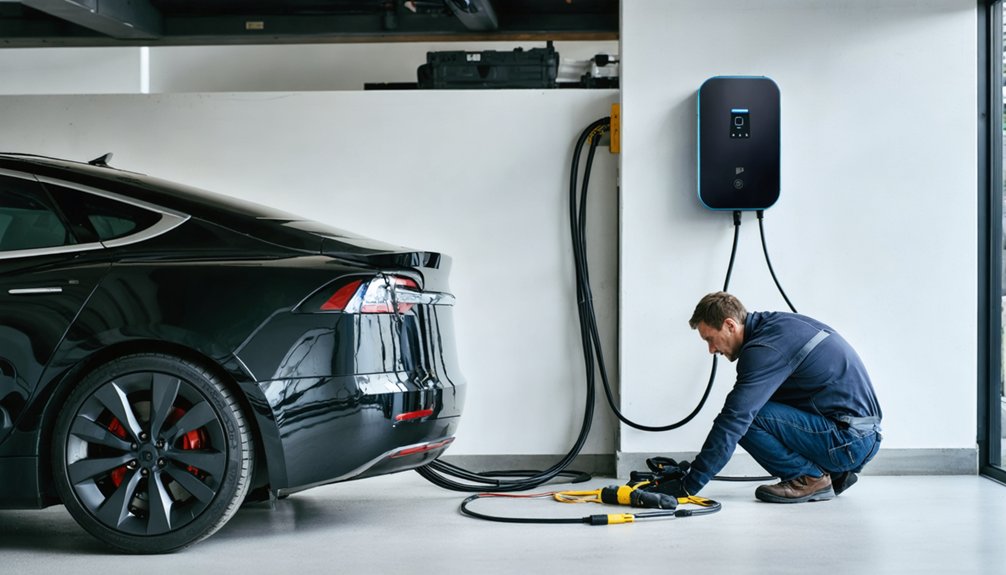

Installing a home EV charger means confirming vehicle connector compatibility, choosing the right charger level, and checking whether the electrical panel can support a dedicated 240-volt circuit. Level 2 chargers usually need proper breaker sizing, conduit, and permit approval under local code. Placement near the parking spot and panel helps reduce cost and clutter. Because wiring errors can create safety, inspection, and insurance problems, licensed electricians are usually the safest choice. Key details ahead make the process clearer.
Highlights
- Most home EV chargers are Level 2 units requiring a dedicated 240V circuit, with charging speed and connector type matched to your vehicle.
- A licensed electrician should verify panel capacity, perform load calculations, and size breakers and wiring to meet code safely.
- Installation permits and inspections are often required, and documentation may include site plans, electrical schematics, and equipment datasheets.
- Charger placement near your usual parking spot and electrical panel helps reduce installation cost, cable clutter, and energy loss.
- Professional installation typically costs $600–$2,000, improves safety and code compliance, and helps protect warranties and insurance coverage.
What Home EV Charger Installation Involves
Most home EV charger installations involve four core elements: code compliance, placement, electrical work, and final testing.
Permits are typically required under local codes, and a licensed electrician usually manages applications, inspections, and documentation.
That process helps protect safety, avoids fines, and supports warranty terms for the charger and related equipment.
Placement is chosen for easy daily access, usually in a garage, driveway, or carport.
A shorter distance to the vehicle reduces cable length and power loss.
Dry indoor areas or weatherproof outdoor setups are standard, with mounting height and wall strength considered for reliable use.
Electricians assess the site, mount the unit, run conduit and conductors, connect terminals, and complete grounding.
A dedicated 240V circuit is typical. Level 2 chargers use 240V power similar to many common residential appliances. Many homeowners also choose units with smart charging features like scheduling and energy monitoring to reduce electricity costs.
The breaker is typically sized at least 125% of the charger’s continuous load to meet code requirements.
Testing confirms safe operation, charging performance, app setup, and practical cord storage.
Can Your Electrical Panel Handle an EV Charger?
Whether a home’s electrical panel can support an EV charger depends on its total available capacity, existing household load, and the charger’s continuous power demand.
Panel capacity matters most: many 200-amp panels can accommodate Level 2 charging, while 100-amp panels may support only 30- to 40-amp charging, depending on overall usage. Most electricians also apply an 80% safety margin when calculating whether the panel can handle the added EV load.
A professional load calculation determines whether major appliances, electric heat, or air conditioning already push the system near its limit.
Because EV chargers are continuous loads, they require dedicated 240-volt circuits and correctly sized double-pole breakers under NEC rules. A qualified electrician should also inspect the panel, wiring, and circuits to verify code compliance.
Homes with 60-amp service, older equipment, or no open breaker spaces often need upgrades.
A licensed electrician can confirm safe capacity, grounding, and wiring, or recommend load management devices when a full panel replacement is unnecessary. About 20% of homes need electrical upgrades before installing an EV charger.
Which Home EV Charger Type Fits Best?
Choosing the right home EV charger depends on the vehicle’s battery size, daily driving needs, charging window, and the home’s available electrical capacity.
Level 1 chargers use a standard 120V outlet, deliver about 1.4 kW, and add only 3 to 5 miles of range per hour, making them best for plug-in hybrids or very short commutes. They generally take 40-50+ hours to bring a battery-electric vehicle to 80% from empty.
Level 2 chargers are the usual fit for households seeking dependable overnight charging. They use 240V power, provide 7.2 to 19.2 kW, and can refill most EVs in 4 to 10 hours. Upfront cost typically runs $300 to $800. Buyers should also match connector type—J1772, NACS, or an adapter—to the vehicle. Models with adjustable amperage and smart scheduling help households charge efficiently and feel confidently aligned. Hardwired installations are generally preferred for reliability and safety. For safety, remember the 80% continuous-load rule: a 50-amp circuit supports only 40 amps of continuous EV charging.
Where Should You Install Your EV Charger?
The best installation spot is usually inside the garage, where the charger stays protected from weather, remains more secure, and is easiest to use during daily parking. Placement near the usual parking position reduces cable stretch, clutter, and daily hassle. For households with more than one EV, a central location can improve access and support future scalability. Adequate ventilation and clearance also matter for heat management and safe operation. Using a wall-mounted holder or retractable reel improves cable management and helps prevent tripping hazards. Both indoor and outdoor installations typically require a permit requirement from insurers and local authorities.
A spot closer to the electrical panel often lowers installation disruption and cost, while helping electricians plan a cleaner route that meets code. The charger should align with the vehicle’s charging-port side and normal parking habits. If outdoor installation is necessary, a weather-resistant unit, raised placement, solid mounting, and good lighting are essential. Aesthetic integration should complement accessibility, visibility, and security. Many homes need a 240‑V circuit for faster Level 2 charging installation.
What Wiring and Breaker Size Do You Need?
How much wiring and breaker capacity an EV charger needs depends on its continuous charging load and the panel’s available capacity.
Most Level 2 units run on 240 volts and use a dedicated dual-pole circuit.
Under NEC 625, breakers and conductors are sized to 125% of the charger’s continuous load, so circuit rating matters immediately.
A 40-amp charger often fits a 50-amp circuit, while higher-output units may need 60-amp or even 70-amp protection.
Each charging station also requires its own dedicated circuit under NEC 625.
Wire size follows breaker size and run conditions.
Eight-gauge wire is common for 40-amp circuits, while No. 6 THHN is often paired with 50- or 60-amp breakers.
THHN conductors typically run in conduit, making conduit sizing important for heat control and future service.
Homes with 200-amp panels usually accommodate this more easily than 100-amp systems.
In homes with limited panel capacity, a load management device can help prioritize EV charging without immediately requiring a full service upgrade.
Which Permits Are Required for EV Charger Installation?
Permits are typically required before an EV charger is installed, with the electrical permit serving as the baseline requirement in most jurisdictions. Its purpose is to confirm safe wiring, proper load calculations, and compliance with local codes. A building permit may also apply when installation involves new construction or structural alterations, though simple parking re-striping or signage often falls under Permit exemptions.
For homes, authorities commonly request site plans, electrical schematics, a completed circuit card, and sometimes manufacturer datasheets. Owner-builders usually must sign verification forms.
Commercial or public-facing chargers often require additional documentation, including ADA compliance plans, parking layouts, project contact forms, and proof of electrical contracting licensure. Some sites may also face zoning review or Zoning variances. In California, streamlined rules can shorten review timelines for qualifying applications. Many jurisdictions now also require permit materials and review steps to be available through online permitting systems.
Should You Hire a Pro for EV Charger Installation?
Why hire a professional for EV charger installation? Licensed electricians reduce risks that DIY work often creates, including unsafe charging, grounding errors, overloaded panels, and potential fire hazards.
They understand high-voltage systems, breaker compatibility, and NEC and local code requirements, helping households avoid failed inspections, fines, and rework.
Professional installation also protects warranty coverage and limits insurance implications tied to faulty wiring or denied claims.
The main objection is cost cost: professional installation commonly runs $600 to $2,000, excluding the charger. Yet DIY mistakes can trigger repairs, added inspections, and poor charger performance that erase early savings.
Certified installers usually finish the job in a few hours, tailor the setup to the home, and deliver reliable Level 2 charging.
For many households, that reliability, safety, and support make professional installation the stronger choice.
References
- https://www.youtube.com/watch?v=87joDusz_ic
- https://www.epa.gov/greenvehicles/getting-started-home-ev-charging
- https://www.youtube.com/watch?v=AU54iaVoWvA
- https://qmerit.com/blog/how-to-install-an-ev-charger-at-home/
- https://www.eaton.com/content/dam/eaton/products/electrical-circuit-protection/circuit-breakers/ev-charging-circuit-breaker/ev-wall-charger-installation-guide-IL91011EN.pdf
- https://www.emporiaenergy.com/blog/a-comprehensive-guide-to-level-2-ev-charger-installation/
- https://a1solarstore.com/blog/ev-charger-installation-your-complete-guide-to-home-charging-setup.html
- https://www.youtube.com/watch?v=z2h0SL0WRqU
- https://evdances.com/blogs/electric-vehicles-charging-knowledge-for-first-time-users/how-to-install-a-home-ev-charger-step-by-step-for-first-time-users
- https://www.constellation.com/energy-101/energy-innovation/installing-ev-charger-at-home.html