

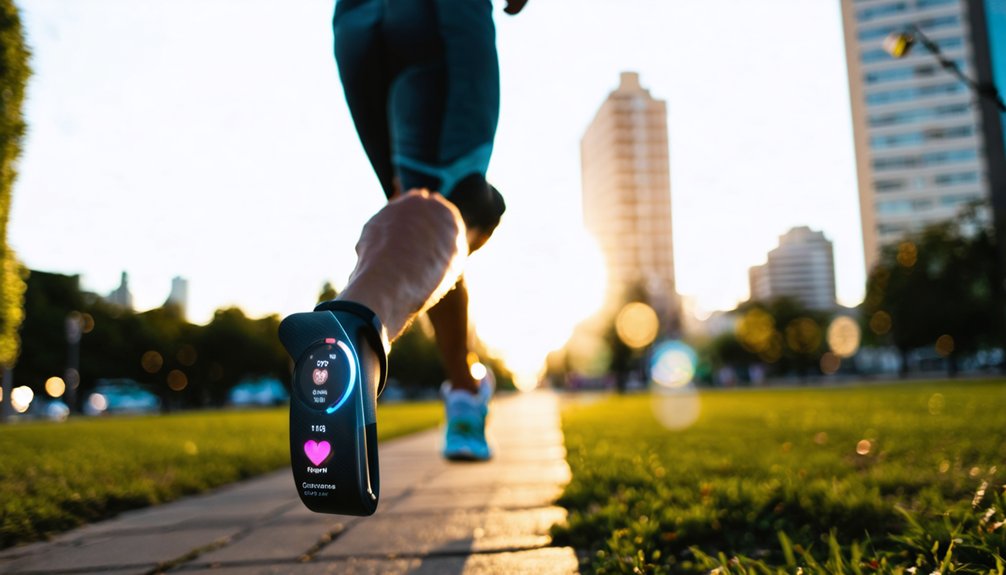

Wearable devices track health trends by continuously collecting motion and biosignal data through sensors such as accelerometers, optical heart monitors, ECG electrodes, and sleep trackers. They send data to phones or cloud platforms, where algorithms compare daily patterns against personal baselines. This helps identify shifts in activity, heart rhythm, breathing, sleep, stress, and recovery early. Some devices also support medical alerts and remote care, while important limits around accuracy, privacy, and access remain worth exploring.
Highlights
- Wearables use motion sensors and biosensors to continuously capture activity, heart rate, breathing, sleep, and stress signals throughout daily life.
- Devices sync data to phones, health apps, and cloud platforms, enabling long-term trend tracking and easier clinician or caregiver review.
- They compare daily measurements against personal baselines to detect unusual changes in heart rhythm, recovery, breathing, temperature, or sleep.
- AI combines multiple signals to reduce noise and identify early warning patterns linked to stress, arrhythmias, chronic disease, and mental health changes.
- Tracking accuracy, privacy risks, skin-tone bias, disability access barriers, and cost can limit how reliably wearables reflect health trends.
How Wearable Devices Collect Health Data
Wearable devices collect health data through embedded sensors that continuously measure movement, essential signs, and other biometric signals during daily life. IMUs in smartwatches quantify motion, while biosensors in clothing capture heart activity, breathing rate, and related signals. Headbands, textile sensors, and sociometric badges extend measurement across everyday settings with high sensitivity. Because many consumer wearables are not FDA-approved, clinicians often treat their readings as adjunctive data rather than definitive medical evidence.
Collected data move automatically through Bluetooth or Wi‑Fi to smartphones, tablets, and cloud platforms for processing. Integration with Apple Health, Google Fit, Samsung Health, and some Electronic Health Records supports timely review in research and care. Broad support for platforms like Fitbit and Apple Watch strengthens device compatibility across research programs. In 2022, wearable use reached 36.36% of US adults, highlighting growing adoption of these tools for everyday health tracking.
A one‑time digital setup can enable ongoing transmission with minimal effort, helping people feel supported within connected health communities. Expert evaluation also emphasizes privacy and device ergonomics, because dependable collection improves when devices are secure, comfortable, and consistently worn.
Which Health Trends Wearable Devices Track
Across daily life, these devices track health trends by converting continuous sensor data into measures of activity, cardiovascular status, sleep, recovery, and stress.
Common outputs include step counts, distance, stairs climbed, exercise heart rate, calorie burn, and energy expenditure, offering a shared overview of movement patterns and fitness habits across routines. Research comparing wearables with reference tools found that heart rate and step counts are generally more reliable than calorie estimates, with high calorie error remaining a consistent limitation.
They also follow cardiovascular indicators such as resting heart rate, heart rate variability, oxygen saturation, and, in some models, heart rhythm. Yet despite this potential, adults with or at risk for cardiovascular disease show lower wearable use than the broader adult population. Some devices can now detect conditions such as atrial fibrillation, reflecting their shift toward clinical tools.
Sleep tracking estimates light, deep, and REM phases, then combines duration and continuity into sleep quality and recovery scores.
Stress monitoring uses heart rate variability, skin conductance, and autonomic signals to estimate strain within personal situation.
Wearables are also used in chronic disease monitoring, including cardiovascular conditions, COPD, and neurodegenerative disorders through movement trends.
How Wearable Devices Spot Changes Early
By continuously comparing incoming biosensor data with an individual’s established baseline, these devices can flag subtle deviations in heart rate, breathing rate, temperature, blood pressure trends, sleep, and recovery before symptoms become obvious.
This supports early detection by identifying irregular heart rhythms, respiratory changes, stress markers, and recovery shifts during daily life, not only in clinical settings. In mental health, continuous wearable monitoring can also reveal early behavioral changes that traditional self-reports may miss.
Evidence from wearable studies shows strong performance across conditions. Multi-modal systems that combine several biosignals can produce a more complete health snapshot than any single metric alone. This evidence comes from a PRISMA-guided review of 28 studies involving more than 1.2 million participants, highlighting real-world accuracy.
Devices have identified COVID-19 in 88 of 100 individuals and atrial fibrillation in 87 of 100 cases, while some fall detection systems perform even better for dangerous events.
Tools such as Apple Watch, Fitbit, Oura Ring, and Hexoskin help users feel supported through continuous monitoring, provided data privacy protections remain clear, transparent, and trusted by the communities who rely on them.
How AI Turns Wearable Data Into Insights
How does raw sensor data become useful health guidance? AI interprets continuous streams from heart rate, blood oxygen, movement, temperature, sleep, and voice biomarkers to find patterns people alone could miss.
Machine learning builds personal baselines over time, then flags deviations several standard deviations from normal.
Multimodal analysis helps separate true physiological changes from sensor noise, improving confidence. Because people spend less than 1% of their time in clinics, wearables fill the real-world gap with continuous daily data.
Evidence shows these systems can detect arrhythmias from ECG data with 95% accuracy and stress from heart and respiratory signals with 93% accuracy. Research also shows multimodal AI can detect subtle health changes missed by single-parameter tools through multimodal detection.
By combining historical trends with current signals, predictive models estimate risks for conditions such as hypertension or diabetes and identify changes before symptoms appear. In diabetes care, CGMs add real-time glucose data that helps AI detect glycemic excursions earlier and personalize guidance.
Explainability tools such as Shapley Additive Explanations support clinician trust, while AI ethics and data privacy remain central to responsible, community-centered use.
Which Wearable Devices Offer Medical Alerts
Several wearable devices now pair emergency alerts with health monitoring, giving users rapid access to help at home and on the go.
Medical Guardian stands out with necklace, wrist, belt clip, and smartwatch options, plus GPS, two-way speaker, and fall detection add-ons. Its water-resistant wearables are designed for use in humid areas like bathrooms, helping extend protection where many slips happen. It scored 9.9/10, with a 29-second average emergency response and up to five days of battery life. Its devices also offer a caregiver app with the MyGuardian Portal, Care Circle, and location history.
Bay Alarm Medical also performs strongly, posting response times of 30 seconds or less after 5,000 hours of testing.
ADT Medical Alert offers clearer price alert integration, starting at $26.99 monthly, with automatic fall detection pendants across plans.
Medical Alert emphasizes simple setup and GPS-based mobile coverage. Its mobile system also includes 24/7 monitoring through U.S.-based live response specialists and a two-way speaker for communication.
Apple Watch adds emergency alert integration through fall detection, ECG, and irregular rhythm notifications, helping many users feel supported and connected daily.
How Wearable Devices Support Remote Care
Wearable devices extend remote care beyond clinic walls by supplying continuous, real-time health data that clinicians can review between visits.
Most research centers on watches, bracelets, and wrist-worn bands equipped with accelerometers, PPG sensors, and biopotential meters to track gait, heart rate, sleep, tremors, and oxygen patterns.
These tools support telehealth by enabling 24/7 observation in everyday settings, especially for cardiovascular and neurological conditions.
Evidence links remote patient monitoring to shorter hospital stays, fewer readmissions, lower costs, and less clinician burden, with one medical center reporting a 76% reduction in readmissions.
FDA-approved smartwatches and medical-grade wearables also help personalize treatment through trends such as resting heart rate.
Effective privacy monitoring integration and data security compliance strengthen trust, helping more people feel connected to care teams and included in ongoing support.
Where Wearable Devices Still Fall Short
Although these devices broaden access to health monitoring, important limitations remain in accuracy, equity, privacy, and accountability.
Studies report activity‑tracking errors of up to 25%, calorie estimates with high mean absolute percentage error, and inconsistent heart rate or step counts, especially during intense exercise.
Limited environment around sensor data further weakens interpretation.
Privacy gaps persist because many consumer wearables fall outside FDA oversight and HIPAA protections.
Sensitive biometric and location data may be accessible to companies or even family members without clear user awareness, raising concerns about surveillance and breaches.
Demographic bias also affects reliability: PPG‑based sensors often perform worse on darker skin tones, while limited research diversity, disability access barriers, and socioeconomic divides exclude many people from fully benefiting.
User over‑reliance and weak manufacturer evidence remain concerns.
References
- https://counterpointresearch.com/en/insights/ces-2026-wearables-market-overview
- https://www.jointcorp.com/fitness-tracker-market-trends-2026-whats-next-in-wearable-health-technology/
- https://www.smartdatainc.com/knowledge-hub/why-wearable-health-tech-is-booming-in-2026/
- https://clutch.co/resources/wearable-technology-trends
- https://leapsandrebounds.com/blogs/news/top-wearable-fitness-monitor-picks-for-2026-stay-ahead-of-your-health-goals
- https://media.market.us/wearable-medical-devices-statistics/
- https://www.intelmarketresearch.com/smart-activity-trackers-market-33189
- https://ajprotech.com/blog/internet-of-things/top-wearables-of-2026-trends-in-health-and-fitness.html
- https://pmc.ncbi.nlm.nih.gov/articles/PMC8402237/
- https://www.vibrenthealth.com/wearable-data-health-research-five-strategies-researchers-need/