

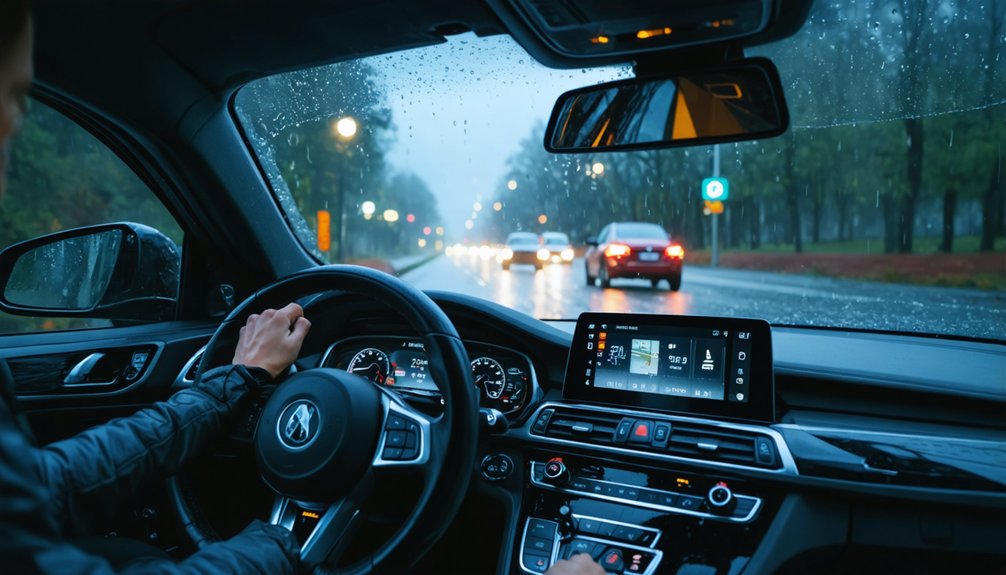

Driver assistance technology improves road safety by spotting hazards faster than most drivers can and responding before a crash happens. Systems such as forward collision warning, automatic emergency braking, lane departure alerts, blind-spot monitoring, and driver-attention checks use cameras, radar, and AI to track risk in real time. Research shows these tools can sharply cut rear-end crashes, injuries, and lane-related incidents. Newer systems are also becoming more predictive, connected, and capable in everyday traffic.
Highlights
- Driver assistance systems warn of hazards like collisions, lane drift, blind spots, and rear cross‑traffic before drivers notice them.
- Safety features like AEB, lane keeping, and stability control can automatically brake or steer to reduce crash risk.
- AI and sensor fusion analyze cameras, radar, and LiDAR in milliseconds to predict threats and cut false alarms.
- Driver monitoring detects distraction, fatigue, and unsafe behavior early, helping fleets coach drivers and prevent violations and injuries.
- Real‑time connectivity and V2X let vehicles share traffic hazards quickly, expanding prevention beyond what onboard sensors can see.
What Driver Assistance Tech Actually Does
Although these systems vary widely in how much they can influence the vehicle, driver assistance technology generally falls into four practical roles: warning about hazards, intervening to reduce crash risk, helping with steering or speed control, and improving driver awareness during parking or low-visibility situations. Research shows that FCW + AEB can reduce front-to-rear crashes with injuries by about 50%. ADAS is generally classified as Level 2 partial automation, meaning it can assist with steering and speed control but still requires the driver’s full attention.
In practice, warnings include forward collision, lane departure, blind spot, rear cross traffic, and parking alerts. Interventions include automatic emergency braking, pedestrian braking, rear automatic braking, blind spot intervention, and flexible brake support. Control assistance covers adaptive cruise control, lane keeping, lane centering, lane-change assist, and traffic jam assistance. Monitoring tools add driver alertness checks, traffic sign recognition, automatic high beams, surround-view cameras, and speed alerts. Parking functions range from backup cameras to remote parking. Across categories, risk detection and sensor fusion support consistent, community-minded road use. New vehicles have also widely adopted the backup camera as a standard reversing aid, and it has been required on all new vehicles since May 2018.
How Driver Assistance Tech Spots Risk Early
Spotting risk early depends on a constant stream of sensor data and fast analysis.
Cameras, radar, and lidar track nearby vehicles, slower traffic, and stationary hazards, while blind spot sensors watch for cars, cyclists, and pedestrians outside normal view. This supports blind spot detection by warning about vehicles and vulnerable road users hidden from mirror view.
Through sensor fusion, systems compare distance, speed, and path to strengthen situational awareness and support shared confidence on the road.
Algorithms then estimate collision likelihood using vehicle speed, object position, traffic patterns, and worst-case deceleration models. Front crash prevention systems can also trigger automatic braking when a driver does not respond in time.
Predictive methods also flag behavioral signals such as harsh braking, speeding, distraction, or rapid acceleration. Insurers can use real-time analysis of this driving data to identify high-risk patterns early.
Some driver attention models refine risk perception by comparing gaze with likely paths, which can reduce false positives.
When danger rises, visual, acoustic, or vibration alerts provide early notice, giving drivers clearer, timelier information for safer decisions together.
Which Driver Assistance Features Prevent Crashes
The value of early risk detection becomes clearer when linked to the features that act on it.
For Crash prevention, Forward Collision Warning cuts rear-end collisions by 27 percent, while Automatic Emergency Braking paired with FCW reduces them by 50 percent and lowers related injuries by 56 percent. With broad adoption, these systems together could theoretically prevent about 14 percent of fatalities in passenger-vehicle crashes. Yet because the U.S. fleet now averages 12.6 years old, the full safety payoff from these technologies will take much longer to reach every driver.
Even when a crash is not fully avoided, AEB can reduce impact speed by 62 percent at 40 mph, supporting Injury mitigation. Electronic Stability Control remains one of the most proven crash-avoidance systems, reducing single-vehicle fatal crashes by as much as 56 percent in major studies.
Lane-based systems also matter to everyday drivers.
Lane Departure Warning reduces all crash types by 11 percent and injuries by 21 percent, with notable benefits for older drivers.
Lane Keeping Assist targets severe road departures and is linked to a 24 percent lower likelihood of fatal departures.
Blind Spot Warning reduces lane-change crashes by 14 percent and injuries by 23 percent overall.
How AI Makes Driver Assistance Smarter
How does driver assistance become more reliable in complex traffic? AI improves it by combining camera, radar, and LiDAR inputs, then interpreting road conditions in milliseconds. Nvidia’s physical AI platform is designed to help systems handle long-tail driving scenarios across different geographies.
This sensor fusion supports features such as lane-keeping and adaptive cruise control, which dominate today’s Level 2 systems and account for 55% of the market in 2026. Continued investment from OEMs and tech firms is accelerating autonomous platforms development and improving these capabilities.
AI also strengthens emergency responses: Autonomous Emergency Braking holds a 13.59% share, reflecting strong demand for pre-impact intervention. With 5G enabling sub-10 ms latency, V2X communication can help driver assistance systems react faster by sharing real-time data from vehicles and infrastructure.
Evidence suggests smarter intervention is reducing harm. AI-analyzed video, spanning 1.2 billion hours, helps identify collision patterns before crashes occur.
In heavy-duty fleets, severe collisions fell 9.5% in 2025 and injuries dropped 7.7%.
Ongoing firmware updates refine performance over time, while AI ethics remains essential for building public trust and shared confidence.
Why Driver Monitoring Tech Matters More
Even as AI sharpens lane-keeping and braking, safety still depends on whether the person behind the wheel remains attentive.
Driver monitoring matters because distraction remains common: nearly half of Americans admit reading texts or emails while driving, and about 660,000 drivers use phones during any daylight moment. In 2023 alone, distracted driving claimed 3,275 lives, underscoring the scale of this deadly toll. Observed hand-held phone use fell from 4.3% of drivers in 2014 to 2.1% in 2023, a steady decline.
Traditional MVR checks done once or twice a year often miss emerging risks, making continuous monitoring essential for timely intervention.
Direct monitoring systems keep drivers engaged five times better than indirect methods and warn about 50 seconds sooner on average.
That earlier intervention can prevent texting, phone use, and other risky lapses, especially when automation encourages overtrust.
Monitoring paired with training cut violations by 77%, while crash injury and fatality rates fell from 17% to 13.5% within three years.
Acceptance also rises when systems respect driver privacy and data security, deliver accurate alerts, and support safe, shared roads for everyone.
What the Latest Road Safety Data Shows
Recent road safety data paints a mixed image: in the United States, collision rates per vehicle rose 4% in 2025, with lower-severity crashes increasing 16% even as higher-severity collisions declined.
Across sectors, near collisions fell 23%, yet inattentiveness surged 168% as a risk factor, and construction fleets saw a 28% increase, highlighting uneven policy safety trends.
Globally, road crashes still cause 1.24 million deaths each year, with low- and middle-income countries carrying the heaviest burden.
Young adults aged 15 to 44 account for 59% of deaths, and men represent 77%.
Vulnerable road users remain central: motorcyclists account for 23% of deaths, pedestrians 22%, and cyclists 5%.
In the United States alone, 40,901 people were killed in 2023, underscoring lasting policy impacts nationwide.
Where Driver Assistance Tech Is Headed Next
As driver assistance technology moves beyond today’s dominant Level 2 and L2++ systems, the next phase centers on broader autonomy, smarter real-time adaptation, and deeper connectivity. Industry progress points toward Level 3 systems taking over in defined conditions, while Level 4 development gains visibility through automaker and supplier demonstrations. Nvidia-backed programs at Mercedes-Benz and Lucid, alongside Volkswagen software plans, suggest faster deployment by mid-2026.
At the same time, AI systems are making assistance feel more natural through road-sensing suspension control, behavior-based maneuvering, and more accurate driver monitoring. future‑X integration also includes V2X links, where studies indicate collision prevention potential reaching 88 percent. Beyond private vehicles, robotaxi scaling by Waymo, Zoox, Uber, Lucid, and Nuro signals a shared path toward safer, connected urban mobility for more communities worldwide.
References
- https://www.lytx.com/news-events/press-release/2026/2026-road-safety-report
- https://www.ccjdigital.com/technology/article/15814836/2026-motive-ai-road-safety-report-highlights-collision-indicators
- https://www.here.com/learn/blog/road-safety-trends-2026
- https://www.prnewswire.com/news-releases/lytx-2026-road-safety-report-reveals-critical-collision-trends-and-urgent-fleet-risk-insights-302723085.html
- https://ulg.law/beyond-the-wheel-how-distracted-driving-death-statistics-impact-us-all/
- https://www.trafficsafetystore.com/blog/traffic-safety-2025-review-key-trends-2026-outlook/
- https://injuryfacts.nsc.org/motor-vehicle/occupant-protection/advanced-driver-assistance-systems/data-details/
- https://www.cbtnews.com/americas-road-safety-crisis/
- https://aashtojournal.transportation.org/several-state-dots-spotlight-traffic-safety-improvements/
- https://www.nhtsa.gov/vehicle-safety/driver-assistance-technologies